

You’ve hired an employee on a six-month probationary period. Four months into the job, things aren’t working out, expectations haven’t been met, and you’re considering ending their employment.
You believe you only need to give one week’s notice because they’re still on probation. But when you check their employment contract, it specifies four weeks. Which one applies?
This is where an otherwise straightforward employment decision can become complicated. To understand why, it helps to know where employment conditions come from and what a probationary period actually means.
Where do employment conditions come from?
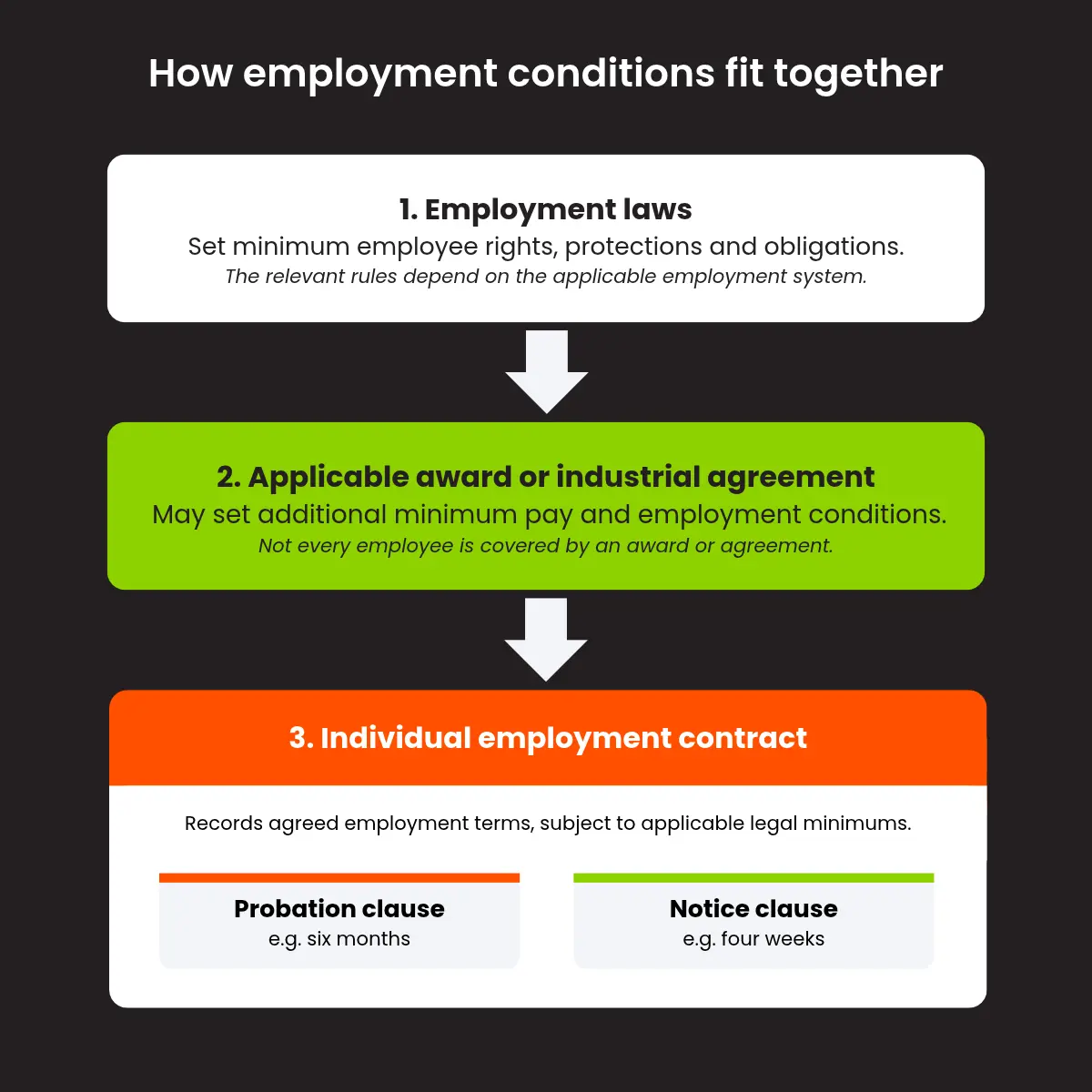
When you hire someone, you generally offer them an employment contract. This sets out the agreed terms of employment, including matters such as their position, salary, working hours and notice period.
The contract may be prepared by your HR adviser, an employment lawyer or the business itself. It may also be based on an existing contract template.
But an employment contract isn’t simply a document in which you can write whatever conditions you prefer. Australian employment laws establish minimum employee entitlements. Depending on the employer and the role, an award or industrial agreement may also apply.
These requirements determine the minimum conditions that must be provided. Your employment contract can offer more favourable conditions, but it cannot take away minimum legal entitlements.
For example, if the applicable minimum notice period is one week, you may agree to give an employee four weeks. However, you cannot simply decide to provide less than the legal minimum.
Once an employer and employee agree to a valid contractual condition, both parties are bound by that agreement.
How does probation fit into the employment contract?
A probationary period is generally an arrangement established when someone starts employment. It gives you time to assess whether the employee is suitable for the position, including their ability to perform the work, meet expectations and work effectively within the organisation.
The Fair Work Ombudsman explains that employers commonly establish probationary periods of three to six months.
When an employer establishes a probationary period, the duration and conditions should be clearly documented in the employee’s employment contract or letter of engagement.
But being on probation does not change an employee’s existing entitlements. Any different contractual arrangements that apply specifically during probation must be clearly established and comply with the relevant employment laws.
Consider these three distinct concepts:
Term | What it actually means |
Probation period | The initial period during which you assess the employee’s suitability. |
Termination notice | The notice you must provide, or pay in lieu, when ending employment, subject to applicable requirements. |
Minimum employment period | The length of service generally required before an employee can qualify for unfair dismissal protection under the national system. |
These concepts can overlap during the first few months of employment, but they serve different purposes. And this is where misunderstandings often arise.
Why probation doesn’t automatically mean one week’s notice
Let’s return to our original example. An employee has worked for four months and is still within a six-month probationary period.
Under the National Employment Standards, an eligible permanent employee with no more than one year’s continuous service is generally entitled to at least one week’s notice of termination. That one-year threshold isn’t a probation period. It is simply the length-of-service category used to determine minimum notice.
An employer and employee can agree to a different notice period during probation, provided it meets the applicable legal requirements. For example, they could agree to one week’s notice during probation and four weeks afterwards.
But in our example, the employer and employee agreed to four weeks’ notice. They did not agree to a shorter notice period during probation. This means the employer cannot simply assume that one week’s notice is sufficient because the employee hasn’t completed probation.
The contract may require four weeks’ notice, even though the statutory minimum is only one week.
A real example from Western Australia
This distinction was demonstrated in a case heard by the Western Australian Industrial Relations Commission.
An employer terminated a general manager’s employment during a six-month trial period and provided one week’s notice. However, when the employee was hired, both parties agreed to two months’ notice. They also agreed to a six-month trial period, but made no provision for a shorter notice period during that time.
The Commission found that the contractual notice provision applied and ordered the employer to pay an additional seven weeks’ notice. The amount was $22,884.62.
The important lesson isn’t the amount itself. It’s that the employer’s understanding of probation did not change the termination notice they had agreed to when hiring the employee.
An additional consideration for WA employers
Understanding the notice period is only one part of the decision. For employers in Western Australia, another important consideration is which industrial relations system governs the employment relationship.
Western Australia has two industrial relations systems: the national Fair Work system and the WA state industrial relations system. Which one applies generally depends on the legal structure of the employer.
For example, most incorporated trading companies fall under the national system, while sole traders and many unincorporated partnerships fall under the WA state system. This matters because the rules for unfair dismissal eligibility are not identical.
Under the national system, employees generally need at least six months’ service to qualify for unfair dismissal protection, or twelve months if employed by a small business with fewer than 15 employees.
Under the WA state system, eligible employees may make an unfair dismissal claim even during probation or with less than three months’ service. The Commission considers these circumstances when assessing the claim.
So, before making a dismissal decision, it is important to know which system governs the employment relationship. Also remember that unfair dismissal eligibility is a separate issue from contractual notice. Even an employee who cannot bring an unfair dismissal claim may still be entitled to notice and protected from certain unlawful reasons for dismissal.
What should you establish before ending employment during probation?
You don’t necessarily need to undertake a lengthy performance improvement process every time an employee is unsuccessful during probation. However, you do need to make a properly informed decision.
Before proceeding, consider these four questions:
- What notice period did we agree to when the employee was hired?
- Does the employment contract provide different conditions during probation?
- Which employment system, award or industrial agreement applies?
- Have we clearly communicated our concerns and given the employee an appropriate opportunity to respond?
Establishing these matters before making a final decision helps you manage probation consistently, fairly and in accordance with your obligations.
The contract should be clear before the employee starts
Probation is intended to help employers and employees establish whether the employment relationship is suitable. But the time to understand your contractual obligations is when you hire an employee, not when you’re considering ending their employment.
Clear contracts, properly established probation arrangements and consistent management practices give business owners and managers a sounder basis for making employment decisions.
As businesses grow, those foundations become increasingly important, particularly when employment contracts have been reused, adapted or inherited from earlier arrangements.
Before you decide that an employee hasn’t passed probation, make sure you understand exactly what their employment contract requires.
At Strategic HR Australia, we help employers establish clear employment contracts, appropriate probation arrangements and practical processes for managing employee performance and employment decisions.